
Buying Waterfront in Parksville, Nanaimo, Nanoose Bay, and More: What to Check First
Buying Waterfront in Parksville, Nanaimo, Nanoose Bay, and More: What to Check First
The view sells a waterfront home in about four seconds.
Whether it was a good buy gets decided somewhere less scenic: on the title, in the survey, at the septic tank, and in what the local rules let you build.
Waterfront on Central Vancouver Island comes in a lot of shapes. A walk-on beach in Qualicum Beach. A bluff with a long staircase in Nanoose Bay. A lakefront lot on Long Lake. Each one asks different questions, and most of them are not answered in the listing.
This is the list I work through with buyers before they remove subjects. It is not legal advice, and it does not replace the professionals I name along the way. It is the order I would check things in if it were my own money on the line.
Ocean, lake or river: know which waterfront you are buying
The type of water shapes everything after it: the maintenance, the services, what you can build, and how you will use the shoreline.
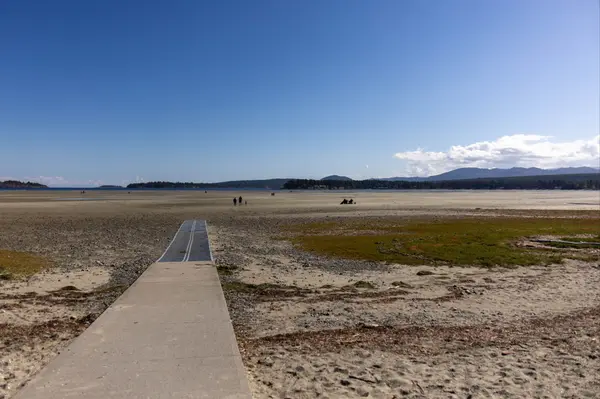
Oceanfront. Salt air is hard on metal, decks, windows and exterior finishes, so plan for upkeep an inland home never needs. The tide also changes the shoreline through the day. In Parksville and Qualicum Beach, low tide can pull the water a long way out across the sand. Around Nanaimo and Nanoose Bay, more of the shoreline is rock. Visit at high tide and at low tide before you decide how you feel about it.
Lakefront. Think Long Lake and Brannen Lake in Nanaimo, or Spider Lake near Qualicum Beach. Water levels move with the seasons. Many lake properties outside city limits run on a well or a lake intake and a septic system, which brings its own checklist further down.
Riverfront. The Nanaimo, Englishman and Little Qualicum rivers are beautiful, and they move. Flooding and bank erosion are the first questions to ask.
Then look at how the land meets the water:
- Walk-on or low-bank. Easy access to the beach and the closest connection to the water. Also the closest to storm surge, king tides and future sea level rise.
- High-bank or bluff. Privacy and a big view, usually with stairs down to the beach. The questions shift to the bank itself: how stable it is, and how close the house sits to the edge.
- Water view or water access. Not the same thing as waterfront. A view across the road or a shared path to the beach is a different property at a different price, so read the listing wording carefully.
Where your property ends and the public beach begins
On most BC waterfront, your title stops at the natural boundary, not at the water.
The Land Act defines the natural boundary as the visible high water mark: the line where the water has left its mark on the soil and plants, year after year. Below that line, the foreshore belongs to the Province, and the public keeps a common-law right to walk along it (Province of BC). That surprises a lot of buyers the first time someone strolls past at low tide.
The line also moves. Gradual erosion can shrink a lot, and gradual build-up, called accretion, can grow it. Land lost to erosion below the natural boundary becomes Crown land.
Two things I ask for on every waterfront file:
- A current survey. The plan on title may be decades old. A BC Land Surveyor can show where the boundary sits today, and whether stairs, decks, a seawall or a dock cross it.
- Proof of permission for anything below the line. Building on Crown land without authorization is an offence under the Land Act, and the Province can require the structure to come out. A structure a previous owner built without permission does not come with permission when you buy the house.
Docks, moorage and the foreshore
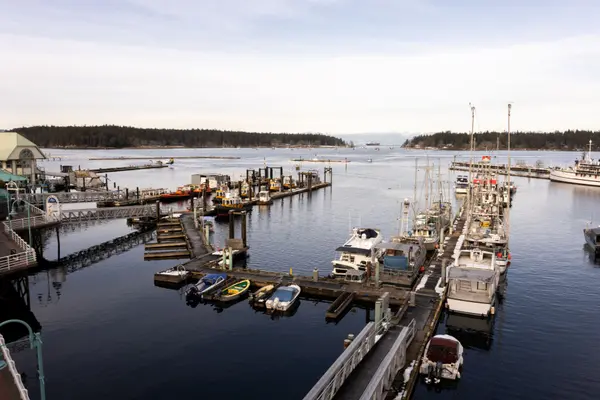
A dock is not part of the land you are buying. It sits on Crown land, and it needs the Province's permission to be there.
Under the Land Act, the Province authorizes private docks in one of three ways (Province of BC):
- General Permission. A dock that meets every condition in the Province's General Permission document is deemed authorized, with no application.
- Specific Permission. Needed when a dock does not meet those conditions. There is a one-time $250 application fee.
- Lease. Used for larger investments where the exact tenure boundary matters. The normal term is 20 years.
The Province's West Coast Region, which covers Vancouver Island and the Gulf Islands, has a partial application-only area: proposed new docks need an application before they are authorized. If a new dock is part of your plan, confirm it with FrontCounter BC before you build it into the price you are willing to pay.
A few rules apply to every private dock. One dock per property. No fill, dredging or solid-core structures. No non-moorage use, so the dock is not a spot for a hot tub. It cannot block public access along the foreshore, and it has to comply with local zoning and bylaws or it is not eligible for authorization at all. Lake and river docks also need a notification under the Water Sustainability Act. Federal agencies can be involved too: Transport Canada for works in navigable water, and Fisheries and Oceans Canada for fish habitat.
The part buyers miss most: the Province's own guidance warns that foreshore tenures do not automatically "go with the property" (Province of BC, Riparian Rights paper). A Specific Permission or lease may need the Province's consent to transfer. Ask the seller for copies of whatever authorization exists, and have your lawyer confirm how it moves to you.
Water supply: where your drinking water comes from
The irony of waterfront: the water at your door is rarely the water in your tap.
- City or community water. The simplest setup. Confirm the connection and any local watering restrictions.
- A well. Using groundwater for household purposes does not need a licence in BC, but the Province encourages registering the well so your water use is on record. Ask the seller whether it is registered (Province of BC). Ask for the well record, a recent flow test and a lab water test. On oceanfront, ask the tester whether the well should also be checked for salt.
- Lake intake. Pumping straight from a lake is a surface water use, and in most cases using surface water in BC requires a water licence from the Province (Province of BC).
If a water licence comes with the property, it transfers to you with the land, and you have to notify FrontCounter BC. From that point you are fully responsible for it (Province of BC). The Province also notes that unpaid water licence rentals are the current landowner's responsibility (Province of BC). That is one more thing for your lawyer to confirm before completion.
Septic systems near the water
Plenty of waterfront outside city sewer runs on an onsite system, and beside the water there is less room for error.
In BC, only an Authorized Person can design, install, repair or maintain a septic system: a Registered Onsite Wastewater Practitioner (ROWP) or a qualified professional. Island Health receives the paperwork, but it does not approve the design (Island Health).
What I ask for before subject removal:
- The records. Ask the seller to pull the Island Health records for the system. Island Health keeps records for systems from 2005 on and for most from 1990 to 2005, so an older system may have none at all.
- A performance inspection. Island Health notes this is the report typically used in a sale. Tell the inspector how many people will live there, and ask them to point out a suitable replacement area, since no system lasts forever.
- The maintenance plan and service history. Systems built under the current regulation come with a maintenance plan, and owners are expected to follow it. Island Health also suggests asking the seller for a declaration of all work done on the system.
If you plan to add bedrooms or a suite, the septic may need to grow with the house. Island Health flags that a bigger building or more bedrooms can trigger an upgrade, so price that in now rather than after you own it.
Setbacks, riparian rules and what you can build
The house you are buying is one thing. What you are allowed to add, rebuild or clear near the water is another.
I have renovated three houses of my own, including relocating a carriage house, and the lesson carries straight over to waterfront: find out what you are allowed to do before you fall for what you want to do.
- Lakes, rivers and creeks. BC's Riparian Areas Protection Regulation asks local governments to protect streamside areas during development, using a science-based assessment by a Qualified Environmental Professional (QEP). The assessment area is generally a 30-metre strip from the high water mark, and the QEP sets the part that has to stay natural. Amendments to the regulation take effect January 1, 2027 (Province of BC).
- Oceanfront. Local governments set their own shoreline rules, often through development permit areas for flood hazard, sea level rise or sensitive habitat. A development permit can be required before you build, add on or reshape the land.
- Archaeology. If the property has a known archaeological site, or could have one, building, adding on, a new septic field or even landscaping can need permits and an archaeologist's assessment first. That can limit where and how you build, and add months and cost to the project. More on this below.
- Trees and plants. Clearing near the water can need a permit as well, so check before you plan the view you want.
- The existing house. Ask whether it meets today's setbacks. An older home that sits closer to the water than current rules allow can limit what you are able to rebuild later.
If you plan to renovate, add a suite or rebuild, call the planning department for that address and request the archaeological information before you write the offer. In this area that could be the City of Nanaimo, the District of Lantzville, the Regional District of Nanaimo, the City of Parksville or the Town of Qualicum Beach.
Erosion, flooding and sea level rise
Two questions every waterfront buyer should ask: what has this shoreline been doing for the last 30 years, and where will the water be in the next 30?
- Sea level rise is already in the rules. In January 2018, the Province amended its flood hazard guidelines so coastal building standards plan for 1.0 metre of sea level rise by 2100. The City of Nanaimo then created a Sea Level Rise development permit area, and its 2018 study flagged parts of Departure Bay, Duke Point, Protection Island and downtown as vulnerable to coastal flooding (City of Nanaimo). The City is updating that work now through its Our Coastal City project (City of Nanaimo, May 2026).
- Flood Construction Level. This is the minimum elevation for living space near the water, built up from high tide, storm surge, wind and waves, plus a safety margin. If the existing house sits below it, that can shape any future addition or rebuild.
- Bluffs and banks. On high-bank lots, ask a geotechnical engineer to look at the bank before subject removal, especially if you plan to build or add on.
- Seawalls. You can protect your land from erosion, but only on your side of the natural boundary. Anything below it needs the Province's consent (Province of BC). The Province also notes that a seawall owner is generally responsible if the wall causes storm damage to neighbouring properties (Province of BC). Ask who built the existing wall, when, and with what permits.
- Insurance. Call your insurer before subject removal, not after. Ask specifically about overland flood and storm surge, and get the quote in writing.
Oil tanks in older waterfront homes
Older homes may have been heated with oil at some point in their life, and a buried tank near the water is not something you want to find after you move in.
- Ask the seller directly whether the home ever had oil heat, and whether a tank was removed.
- Look for clues: an old fill pipe or vent on the exterior wall, or a capped line in the basement.
- If there is any doubt, a tank scan can locate a buried tank before you remove subjects.
- If a tank was removed, ask for the removal paperwork and any soil testing.
- Ask your insurer early. Some have their own requirements for homes with an oil tank, past or present.
Archaeology and the Heritage Conservation Act
People have lived along this coastline for thousands of years, so archaeological sites tend to sit close to the water.
BC's Heritage Conservation Act protects archaeological sites on public and private land, whether or not they have been recorded, and even if they were disturbed in the past. Construction, renovations and landscaping can all damage a site, and owners are legally responsible for making sure one is not disturbed without a permit (Province of BC).
The trade-off: the Province notes that waterfront sites are usually close to the water and often already sit inside zoning setbacks, so a site may not change how you use the house day to day. Building is where it can change everything.
If a property has a known archaeological site, or could have one, here is what that can mean for any plan to build, add on, put in a new septic field or even landscape:
- Permits before you dig. An archaeologist may need a heritage inspection permit to assess the site, which often includes test digging. If a site is present, you need an alteration permit before it is disturbed, and some work has to happen with an archaeologist overseeing it.
- Limits on where and how you build. The Province points owners toward low-impact approaches, like shifting where a structure sits, building on pads or piles, or building up on clean fill instead of digging down. The design you had in mind may not be the one you can build.
- Time. Some permit applications take over 200 days to process.
- Cost. The information request and the permits are free, but the property owner pays for the archaeological work.
- Your building permit. Many local governments know where protected sites are, and may flag one when you apply for a building, demolition or rezoning permit and ask you to hire a consulting archaeologist.
If you are buying waterfront with any plan to build or renovate, request the archaeological information as early as you can, and before you remove subjects. It can change what the property is worth to you.
Why I recommend a lawyer review on every waterfront purchase
This is the part I feel most strongly about. On waterfront, have a real estate lawyer review the contract and the title before you remove subjects, not only at completion.
Before real estate, I spent eight years in accounting, including estate and executor work at Grant Thornton. The habit I kept from those years: read the documents before you trust the story. On a typical house, most of the paperwork is routine. On waterfront, the title, the boundary, the foreshore and the water rights can each turn into a legal question, and those questions are far easier to answer before you are committed.
What I ask buyers to have their lawyer look at:
- The title and every charge on it. Covenants, easements and rights of way can control where you build, where the septic sits, or what has to happen in a flood zone.
- The survey against what is built. Whether the house, decks, stairs, seawall or dock cross the natural boundary or a neighbour's line.
- Dock and foreshore authorizations. What exists, and what it takes to transfer to you.
- Water licences. Whether one is attached, whether rentals are paid up, and the notice you need to give after completion.
- The subject clauses in your offer. Wording them so you have enough time for the survey, inspections, septic, water testing, insurance and the lawyer's own review.
- Zoning and setbacks. Whether the existing house conforms, and what that means if you ever want to rebuild, including any covenant tied to an archaeological site.
Notaries handle many BC conveyances well. For waterfront, I lean toward a lawyer, because if something on the title or the foreshore turns into a dispute, a lawyer can advise you through it.
A quick note: I am not a lawyer, and nothing in this post is legal advice. My job is to make sure the right questions get asked, by the right person, early enough to matter.
Your waterfront checklist: who to call before subject removal
Here is the whole list in one place, by who handles each piece.
- Real estate lawyer: the contract, the title and its charges, and how any dock tenure or water licence moves to you.
- BC Land Surveyor: where the natural boundary sits today, and whether anything built crosses it.
- Home inspector: ideally one with waterfront experience, for salt exposure, decks, drainage and the building envelope.
- Authorized Person for septic (ROWP or professional): a performance inspection and a suitable replacement area.
- Well professional and an accredited lab: a flow test and a water quality test.
- Geotechnical engineer: the bank on high-bank lots, or any plan to build near the water.
- Your insurer: a written quote, with overland flood and storm surge addressed.
- The local planning department: zoning, setbacks, development permit areas and any Flood Construction Level.
- FrontCounter BC: dock authorizations and water licences.
- The Province's Archaeology Branch: a free archaeological information request, as early as possible if you plan to build, add on or landscape.
- The seller: the Island Health septic records, the well record, and copies of any dock or water licence paperwork.
Which of these become subjects in your offer depends on the property. We talk it through together, and your lawyer can help with the wording.
Waterfront buying FAQ
Do I own the beach in front of a waterfront home in BC?
Usually not. Most BC waterfront titles end at the natural boundary, the visible high water mark, and the foreshore below it belongs to the Province. The public keeps a common-law right to walk along the foreshore.
Does a dock automatically come with a waterfront property?
No. A private dock sits on Crown land and needs provincial authorization through a General Permission, a Specific Permission or a lease. A Specific Permission or lease may need the Province's consent to transfer, so have your lawyer confirm what applies before you remove subjects.
Do I need a water licence for a well or a lake intake?
Household use of a well does not need a licence in BC, though the Province encourages registering the well. Pumping water from a lake is a surface water use, which in most cases requires a water licence. If a licence is attached to the property, it transfers with the land and you must notify FrontCounter BC.
Can I build a seawall to protect my property from erosion?
You can protect your land, but only on your side of the natural boundary. Anything below it needs the Province's consent, and local permits are likely to apply as well.
Should I use a lawyer or a notary to buy waterfront in BC?
Notaries handle many BC conveyances well. For waterfront, I recommend having a real estate lawyer review the contract and title before subject removal, because boundary, foreshore and water rights questions can turn into legal ones.
How do I find out if a property has an archaeological site?
Submit a free archaeological information request to the Province. If a site is present or possible, building, adding on or even landscaping can require permits and an archaeologist's assessment, which can limit where and how you build and add time and cost.
Thinking about waterfront?
Waterfront is the one property type where the view and the paperwork deserve equal attention.
If you are looking at a home on the water in Nanaimo, Lantzville, Nanoose Bay, Parksville or Qualicum Beach, send me the address before you write an offer, and I will tell you what I would check first.
You can reach me at 250.668.8339 or jessica@annexrealestate.ca.
This post is general information about buying waterfront property in British Columbia. It is not legal, tax or engineering advice. Rules change, so confirm the specifics for your property with the professionals named above. Last reviewed October 2026.
Sources
All checked October 3, 2026.
- Land Act, section 1 (natural boundary) and sections 59 to 60 (trespass on Crown land), BC Laws
- Land use: private moorage, Province of BC, updated March 17, 2026
- Seawalls: frequently asked questions, Province of BC, updated September 15, 2025
- Riparian Rights and Public Foreshore Use in the Administration of Aquatic Crown Land, Province of BC, Occasional Paper No. 5, revised August 2008
- Requirements for groundwater users, Province of BC
- Water licensing and rights, Province of BC
- Change the name on a water licence, Province of BC
- Frequently asked questions about water billing, Province of BC
- Sewerage and subdivision, Island Health
- Riparian Areas Protection Regulation, Province of BC, updated March 10, 2026
- Climate adaptation, City of Nanaimo, updated February 2, 2026
- City seeking feedback on strategies to respond to sea level rise, City of Nanaimo, May 19, 2026
- Archaeology: for property owners and developers, Province of BC, updated September 21, 2026
Categories
Recent Posts




GET MORE INFORMATION

Personal Real Estate Corporation